
The world can’t build enough infrastructure. We intend to fix that.
Physical infrastructure advances civilization. From the first aqueduct to the first railway to the first internet cable laid across an ocean floor, every time human society leaped forward, it was because someone built something.
The next leaps forward will be no different. We can have abundant clean energy. We can have data centers that provide affordable computing power. We can have roads and large infrastructure that make communities liveable and improve life across the planet.
We will have all of this when we build it. Physically.
Today, people are fighting to make this transformation happen. Demand for large-scale infrastructure construction has never been greater, and money is lining up behind it.
McKinsey found that the existing construction industry would have to more than double its growth rate to fulfill demand over the next decade and a half. By 2040, we’ll have trillions earmarked for construction that we can’t spend, because there’s no one left to hire.
The challenge isn't ambition, capital, or demand. It's our ability to build. Forty-one percent of the U.S. construction workforce will retire by 2031. Attrition already runs near 70% in the industry. The entire construction workforce, from the back office to the field, is thinning out.
The best EPCs in the country are turning down hundreds of millions in contracts because they can’t confidently source teams to do the work. The projects they do take on are often unpredictable and behind schedule for the same reason.
This is a structural problem, not the result of an economic cycle. Demand for infrastructure is increasing, while the supply of labor is decreasing. There is no version of the future where humans alone close this gap.
Construction never got its automation revolution.
Over the past decades, automation swept through every other industry focused on physical work. Factories, warehouses, assembly lines, and shipping hubs are dramatically more efficient than they once were.
Construction is the only major sector that got less efficient over the last sixty years. Since the mid-1960s, construction productivity has fallen by roughly half, while productivity in sectors like manufacturing and agriculture has increased by 1000% on average.
Every environment that transformed had one thing in common: the ability to control it. When the thing you’re automating sits between four walls, under consistent lighting, with bolts attaching it to the floor, automation is easier.
An outdoor construction site is the opposite of a controlled environment. It's different every day, sometimes every hour. The dependencies are intricate, intense, and constantly in flux. A rainstorm can soak the ground, large machinery can sink a few inches into the mud, and all the geometric and physical calculations associated with the work need to be adjusted. A mis-timed delivery can re-shuffle the day’s work plan by lunch.
Automating large-scale construction is simply a much harder task than society has taken on. So while the rest of the world got robotics, construction got tablets and GPS trackers. These are groundbreaking technologies, but a tool that makes one worker 10% more efficient won’t solve a labor shortfall priced in the trillions.
Physical AI holds great promise, but nearly every product it’s produced to date only runs where it's safe: in a lab, in a demo, on a stage. The work to be done is in the dust, heat, cold, and mud. And the tasks to be automated range from heavy lifting to careful, dexterous work, all done in chaotic conditions.
We need construction intelligence built for the real world, not protected from it.
Gritt: intelligence that does real work on jobsites, today.
Gritt is an intelligent system that combines robotics and AI to build the infrastructure that pulls society forward. It isn't just a robot, and it isn't just an AI model. It's a complete AI system doing real work on real jobsites, right now.
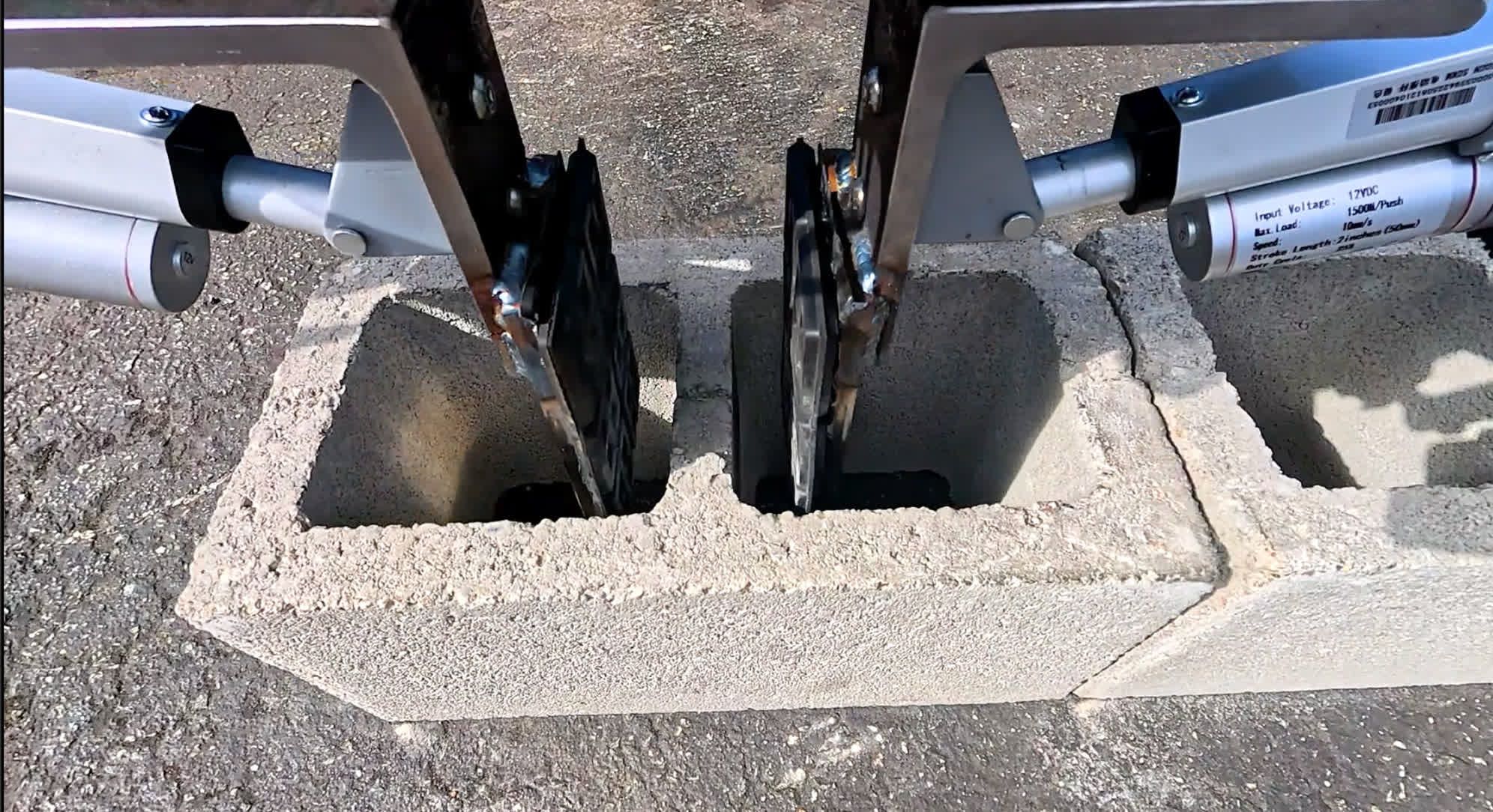
Gritt attaches to existing jobsite equipment, such as skid steers and forklifts, to pick and place, assemble, and transport materials with millimeter precision.
We are a deployment-first AI company. That means we believe intelligence for the physical world has to be built in the physical world, on real sites and in real conditions. It is simply not possible to do what we’re setting out to do in the confines of a lab. So we engineered Gritt from the start with one goal: getting it onto a jobsite and keeping it there.
We want our AI to learn from the field on day one.
That's why we keep the hardware deliberately simple. Instead of designing highly custom, purpose-built machines, we build modular systems out of proven, off-the-shelf components. This makes it simple to add Gritt to the equipment firms already rent. There's no proprietary fleet to buy, no outdoor factory to stand up, and no months-long setup before work begins. We let the hardware stay simple so the intelligence can get to work quickly.
And the intelligence is truly special. Gritt runs on a proprietary AI stack built on our own models, trained to form a single generalized representation of a construction site that supports every task Gritt takes on. We chose this approach because after spending time on different construction sites in a wide variety of terrain and conditions, we saw how much each site had in common. A hard hat is a hard hat, whether it’s baked in desert heat or pelted by snow. Pallets, rebar, and scaffolding, are too.
Our generalized representations are an excellent basis for our models to learn new skills. And when they do, new model weights ship over the air to machines in the field the same way your phone updates overnight. This makes the process of adding capabilities to Gritt incredibly smooth and fast. For example, Gritt learned to tie rebar in about a day. The same underlying knowledge that makes Gritt great at installing solar panels can also be used to lay cinderblocks.
Gritt is already handling repeatable physical tasks, but our intelligence seamlessly transfers to mental work, too.
Gritt can become a decision-making layer on the construction site. Gritt machines can act as the eyes and ears to help verify, plan, and manage work on large, constantly changing projects. It understands the dynamics of the jobsite, how resource allocation decisions are being made, and becomes the right hand of a General Site Supervisor.
The heart of every deployment is, of course, data. Every Gritt deployment contributes to one of the largest troves of real-world construction data anywhere. The more we deploy, the more we learn. The more we learn, the more the system can do. The flywheel will only get faster from here.
Solar is just the beginning. Gritt is expanding across verticals and tasks.
To date, Gritt has installed tens of thousands of solar modules with zero breakages, across live jobsites around the country, at 4X the output of non-automated construction, with no added labor. Top-ten U.S. construction companies are asking us to take on more projects, automate more tasks, and handle more complex processes, and we’re delivering.
Solar is where we started. The need is acute, the work is repeatable, and demand is high. Data centers, energy, and large-scale infrastructure come next.
We’re relentless about getting Gritt in the field today, but we’re also thinking big. We want to build the company that will build the physical world, and we make decisions on that timescale: not for this quarter, but for the next century.
It’s a big job.
If you build AI and you're tired of watching it do clever things in a sandbox, come make it move steel. If you've spent your life on jobsites and wished to see construction overcome its limits, come help us break them. We are bringing together a rare combination of experts in AI, robotics, and construction. If you want to solve the hardest and most impactful problems in AI, take a look at our openings.
We can have the world we want. Gritt is how we build it.
