
Real-to-Sim-to-Real: Scaling Construction AI from Field Experience
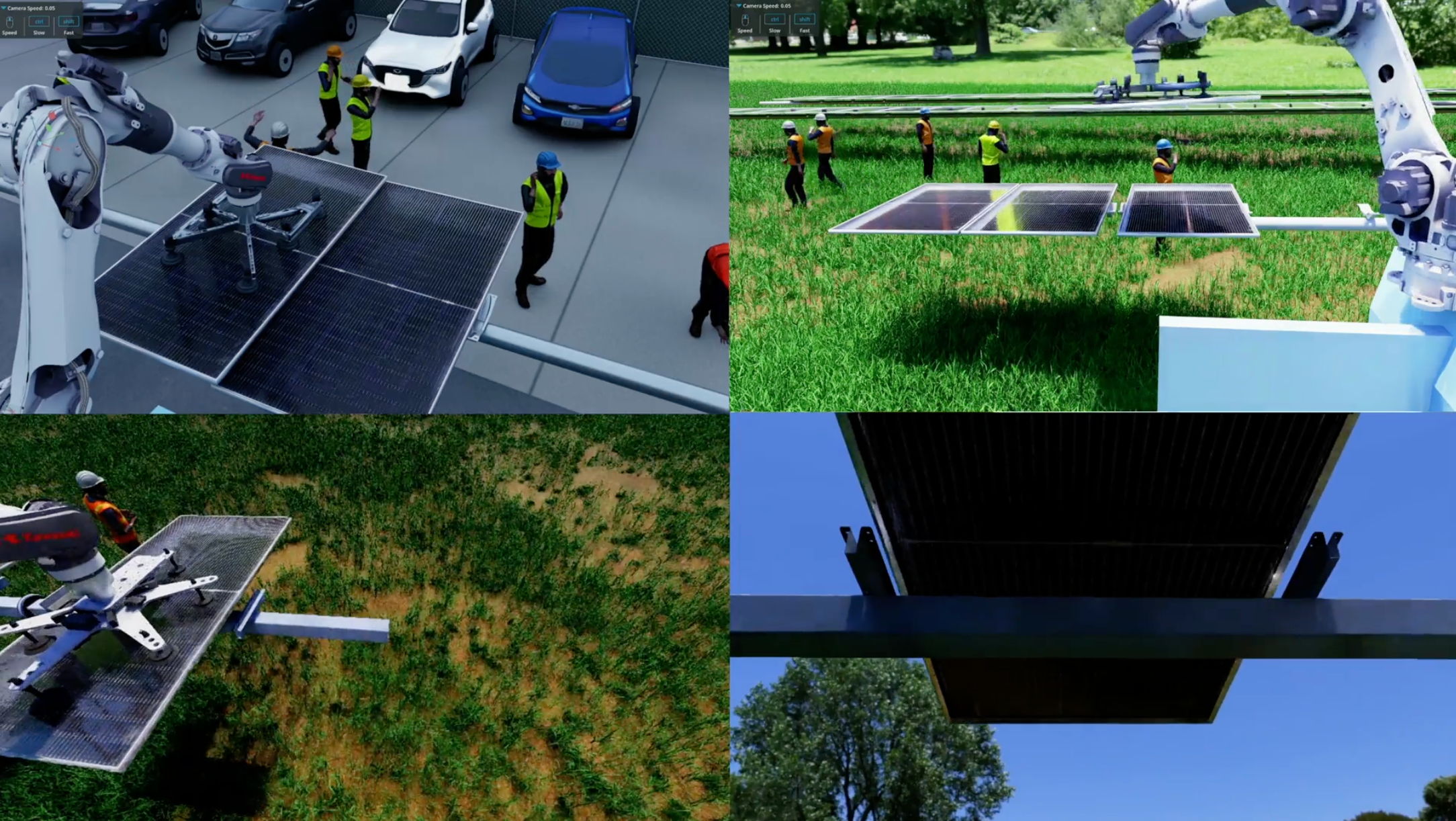
Construction creates a difficult learning environment for physical AI. Job sites change as work progresses and terrain, lighting, weather, equipment, and materials vary across projects. People move through the workspace at will. A model must handle tremendous variability while performing useful work in the physical world.
Real deployment data is essential, but collecting enough examples of every possible situation is impractical. Rare events are especially hard to capture, even when they matter greatly to how a robot should behave.
At Gritt, we’re developing large-scale simulation and world model capabilities for construction tasks and environments. Our approach connects field deployments with synthetic data generation, training, and evaluation in a continuous real-to-sim-to-real loop.
From field data to diverse simulated environments
The process starts with real images and video from the field. These observations seed an automated pipeline that generates synthetic data and 3D environments grounded in actual construction work.
From those starting points, we can vary the conditions a model encounters: terrain, lighting, weather, objects, and scene arrangement. A single observed environment becomes the basis for many variations, expanding the diversity available for training and evaluation.
That diversity matters because construction AI must generalize across changing conditions. A task learned in one setting must transfer to another, where surroundings, materials, or visibility may differ. Simulation lets us expand that experience without collecting every variation through a separate field deployment.
Both training and evaluation benefit from this expansion. Models gain a wider range of examples to learn from, and we can examine their behavior under conditions sparsely represented in the original data.
Our work spans simulation and world models, with real data providing the grounding for both. The aim is to amplify the information in each deployment into a much larger set of useful learning experiences.
Preparing for the long tail
Some of the most consequential situations are also among the least common. Consider a worker walking in front of a robot. A training dataset may contain relatively few examples of that event, with limited variation in the surrounding conditions.
In simulation, we can recreate the scenario and generate numerous variations. The model can learn to identify the hazard and respond, while evaluation can probe its behavior across a broader range of circumstances.
This makes simulation valuable for exploring the long tail of construction environments. Instead of waiting for a rare event to recur in the field, we can use an observed situation as the starting point for further training and evaluation.
The purpose is to improve robustness before and between deployments. Exposure to varied scenarios gives us more opportunities to understand where models perform well and where they need further learning.
Every deployment strengthens the flywheel
Simulation’s usefulness depends on its connection to the world in which the robot operates. Gritt’s unique access to active construction tasks and environments supplies the data that grounds this process.
Each deployment brings new observations back into the simulation pipeline. Those observations help us refine the environments and scenarios used for subsequent training and evaluation, progressively narrowing the gap between simulated experience and field conditions.
This deployment-driven data flywheel is central to our approach. Field work provides the seeds. Simulation expands their volume and diversity. Training and evaluation use that expanded experience to prepare models for deployment, which produces the next set of observations.
Over time, we’re building capabilities specific to the tasks, materials, and environments that construction demands. The objective is scalable pre-training and faster generalization to new tasks and settings with less additional real-world data.
Building toward broader construction intelligence
Preparing a robot for a new job site means giving it experience beyond the sites it has already visited. Real-to-sim-to-real turns a smaller sample of field observations into a much broader foundation for learning.
That foundation supports Gritt’s ambition to build AI that can adapt across construction work. Watch Vishal explain the approach in the video above. To help develop these capabilities and put them to work in the field, explore our open roles.
